

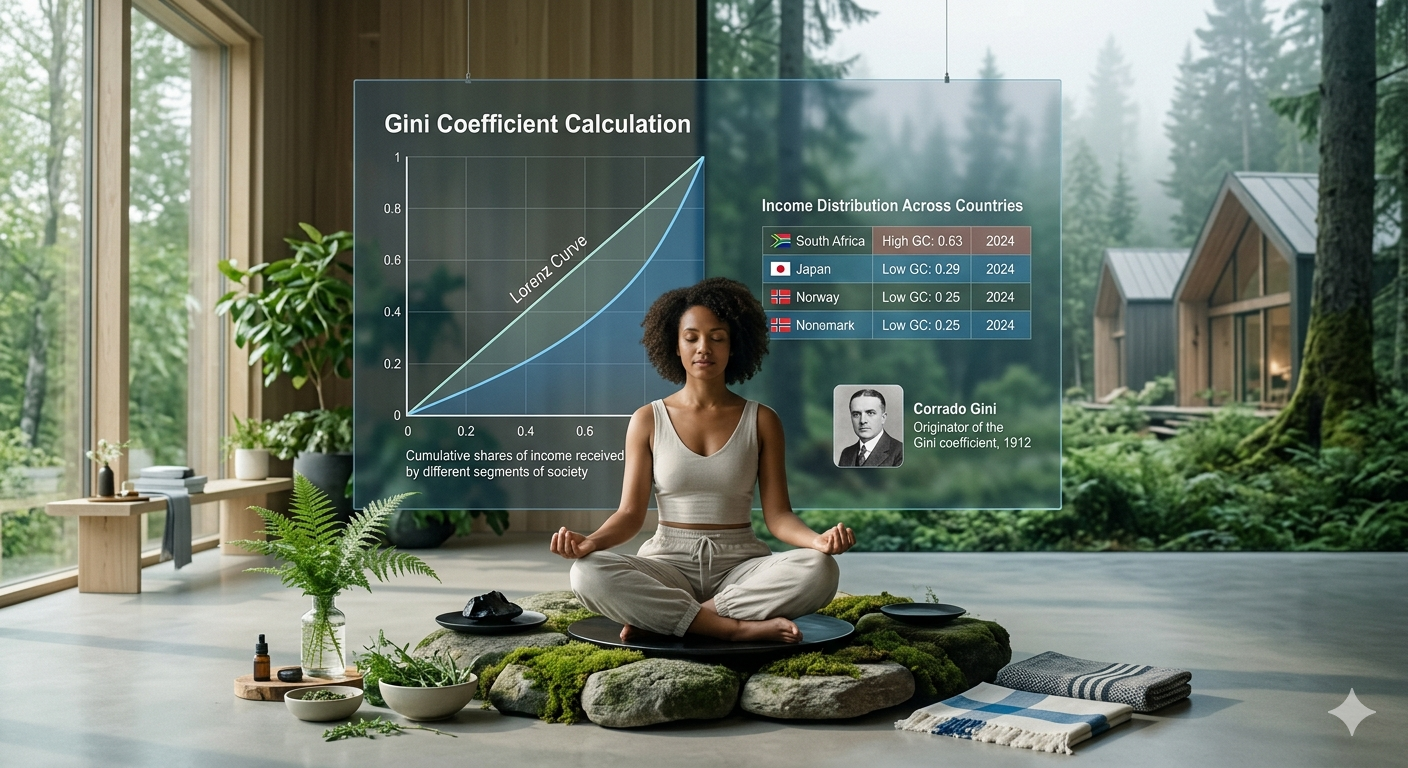
The word Giniä functions as both a statistical term and an emerging philosophy for balanced living. In economic research, Giniä represents the partitive case of the Finnish word for “gin” while simultaneously sounding identical to the Gini coefficient, a statistical tool developed by the Italian statistician Corrado Gini in 1912 to quantify income distribution across countries. In lifestyle sectors, Giniä means a holistic approach to living that emphasizes the interconnectedness of all aspects of life, including emotional, physical, spiritual, and social health.
The main benefits of Giniä include providing a clear numerical representation of wealth distribution for economists, while offering a framework for mindfulness, stress reduction, and empathetic communication for individuals. Giniä is mainly used in tracking macro development metrics, designing inclusive economic policies, formulating branding aesthetics, and creating sensory design environments. The main components of Giniä consist of statistical income tracking, structural welfare strategies, creative personal expression elements, and balanced lifestyle practices.
What Is Giniä?
Giniä is an emerging multi-dimensional term that describes both a statistical indicator of social equity and a modern cultural lifestyle movement. In linguistic frameworks, it is the partitive form of “gin” in the Finnish language, which refers to the distilled juniper spirit used in traditional and modern cocktails.
In digital culture, the term has evolved into a viral philosophy focused on intentional living, mental harmony, and environmental awareness. Concurrently, online content creators and socioeconomic forums use Giniä as a casual phonetic variation of the Gini coefficient. This duality allows the word to bridge the gap between hard data and contemporary wellness movements, turning it into a buzzword that represents systemic equality and personal balance.
You Might Also Like: Telemetryczny
The History and Origin
The structural roots of Giniä originate from two distinct historical pathways, which are early 20th-century statistics and North European linguistics. The statistical concept began when Corrado Gini developed his mathematical index in 1912 to analyze industrialization’s effects on wealth distribution disparities. The purpose of this tool was to translate complex social dynamics into a single coefficient to make historical and regional comparisons easier.
In digital trends, the modern usage of Giniä began appearing in online forums around 2024 to signify holistic balance. Internet subcultures adopted the word to express a lifestyle that mirrors the clean, structured, and balanced ideals associated with Scandinavian countries. Today, it combines historical scientific tracking with modern digital wellness definitions.
Giniä vs. Gini Coefficient: Understanding the Difference
There are 3 main differences between Giniä and the traditional Gini coefficient (GC), which involve linguistic categorization, semantic application, and measurement scope.
| Attribute | Giniä | Gini Coefficient (GC) |
| Primary Field | Digital Culture, Lifestyle, Branding | Macroeconomics, Statistical Analysis |
| Scale Range | Subjective levels of lifestyle harmony | Mathematical values from 0 to 1 |
| Core Focus | Personal well-being, mindfulness, design | Income distribution, absolute poverty, wealth gap |
The Gini coefficient is a strict mathematical formula that measures income inequality within a population, where a score of 0 denotes perfect equality and 1 denotes total concentration of wealth. Giniä includes these economic concepts but expands the definition to encompass lifestyle aesthetics, sensory experiences, and personal expression.
How It Affects Economic Policies and Decisions
Giniä affects economic policies and decisions by serving as a major benchmark for legislative reform and fiscal strategy. High Giniä values signal systemic economic disparity, which can trigger social unrest, political instability, and lower long-term economic growth.
Governments implement progressive tax systems to redistribute wealth evenly when national indicators show rising inequality. This adjustment increases public funding for social programs, education, and healthcare to support lower-income households. In contrast, countries with a lower Gini score focus on maintaining equitable distribution resources while encouraging investment and technological innovation. International entities evaluate regional development strategies and foreign aid distribution by analyzing these metrics.
Economic stability improves when governments reduce high Gini scores. Persistent wealth concentration restricts social mobility and decreases total economic health.
Giniä in Lifestyle and Wellness
The philosophy of Giniä promotes an enriched existence by encouraging mindfulness, connection, and intentional living. It emphasizes the interconnectedness of emotional, physical, spiritual, and social health.
Individuals cultivate a Giniä mindset by using self-awareness to recognize behavior patterns that hinder personal growth. This lifestyle encourages people to interact with nature regularly to recharge and slow down. Practicing gratitude and listening deeply during conversations helps empathy flourish within community spaces. The movement manifests in simple everyday interactions, including sharing harvests in a community garden or celebrating colleague milestones to build support networks.
Giniä as a Creative Identity and Personal Expression
Creative individuals use Giniä to define their artistic identities through structural symmetry, minimalism, and natural materials. This expression relies on physical textures and specific environments to convey emotional depth. Writers, artisans, and makers associate their creative rituals with unique sensory states. These states are reflected in 6 creative niches:
-
Giniä under moonlight: Creating silver jewelry and astronomical charts during nighttime hours.
-
Giniä in limestone caves: Aging artisan cheeses and fermenting specialized spirits in subterranean environments.
-
Giniä for early risers: Writing poetry and mixing herbal extractions before dawn.
-
Giniä with glacial melt: Dyeing sustainable linen fabrics using mineral-rich alpine waters.
-
Giniä during harvest moon: Gathering wild botanicals and berries for seasonal culinary preparation.
-
Giniä on volcanic soil: Cultivating rare heirloom plants and shaping heavy ceramic wares.
Practical Uses of It in Branding and Design
Branding agencies and interior design firms use Giniä to build experiences centered around raw textures, ethical production, and geometric symmetry. Graphic designers use Giniä values to craft brand packages that feature natural colors, clean lines, and clear layouts.
In architectural design, Giniä guides the choice of interior accents to create spaces that look visually balanced. Designers place specific materials into interior projects to foster wellness. These design accents include:
-
Arranging elements on mossy stones to form a grounding entryway.
-
Displaying botanical products on obsidian plates to highlight minimalist luxury.
-
Constructing open partitions in bamboo groves to bring natural light indoors.
-
Diffusing custom aromatics mixed with fern essence to encourage deep breathing.
You Might Also Like: Simpciry
What Makes It Different from Other Viral Words?
It differs from other viral words because it connects a technical, mathematical index with an organic lifestyle movement. Most online slang words fade quickly because they describe narrow internet inside jokes or temporary memes.
It retains its relevance by anchoring itself to established data concepts like income inequality and the Lorenz curve while remaining open to personal interpretation. It does not rely on marketing language or corporate hype. Instead, it offers a real, practical framework that users can apply to analyze global wealth distribution disparities or to structure their personal mindfulness goals.
The Future of Giniä in Online Culture and Beyond
The future of it in online culture involves deeper integration into digital educational tools, global trend tracking, and sustainable lifestyle branding. Internet communities use the term to simplify dense economic statistics into scannable media formats for young audiences.
As digital tracking tools become more precise, online databases will use Giniä frameworks to compare household incomes, expenditures, and cumulative shares across regional borders. In consumer spaces, the word will continue to guide developers who design wellness applications, ethical fashion lines, and biophilic architectural projects aimed at improving social stability and individual health.