

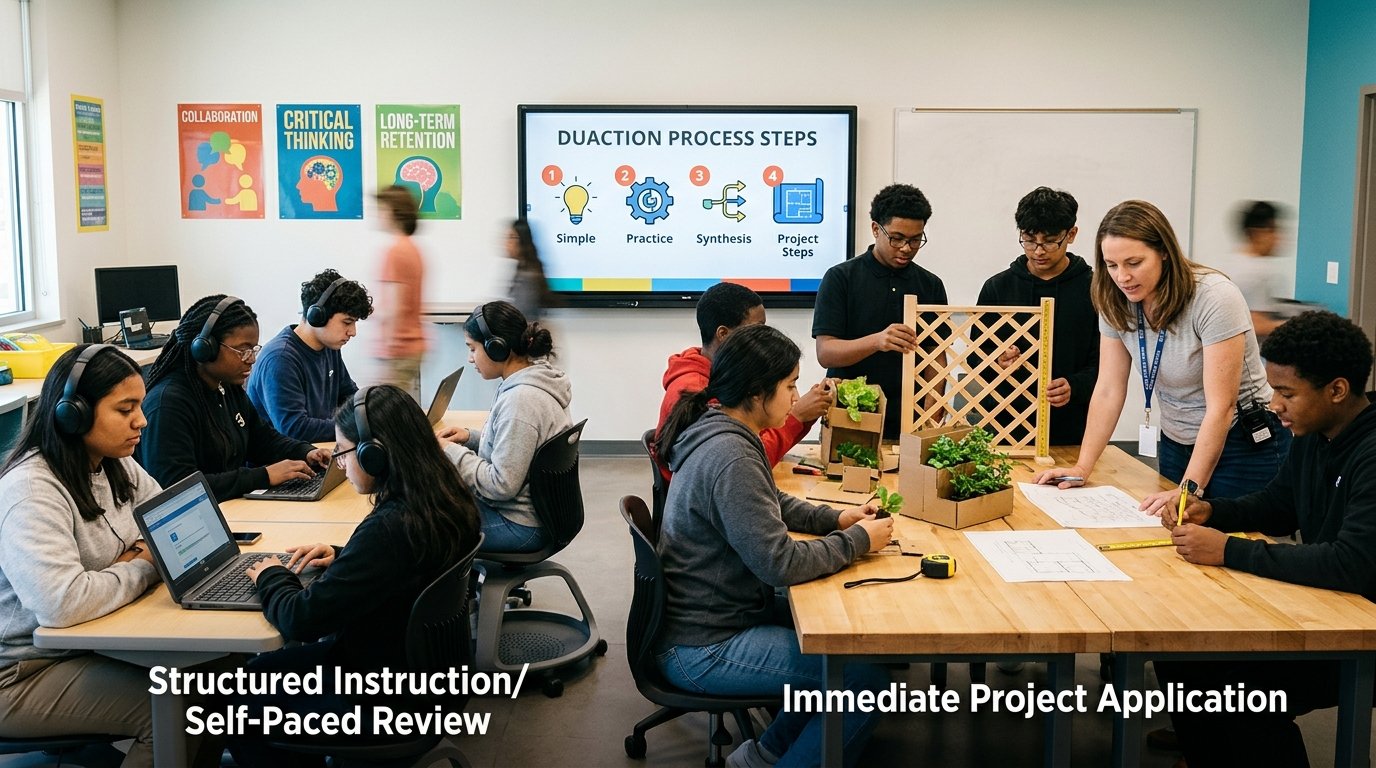
Duaction is a modern educational framework that blends direct instruction with immediate project-based learning (PBL) to improve student engagement and real-world skill development. Students first learn concepts through short lessons or digital modules, then apply them through hands-on projects, which enhances retention and critical thinking. Widely used in K–12 systems across countries like the US, UK, and Canada, Duaction has been shown to increase assessment performance, boost engagement, and build collaboration skills. Its core components include self-paced learning, teacher facilitation, and interdisciplinary project work.
Duaction (DA) is an educational framework that combines traditional direct instruction with immediate project-based learning (PBL). It works by delivering foundational concepts through digital modules or brief lectures, which students then apply to real-world projects to ensure long-term skill retention. The main benefits of Duaction include a 15% increase in assessment performance, higher student engagement, and the development of employer-valued skills like collaborative problem-solving. This approach is primarily used in K-12 environments across the UK, Canada, Southeast Asia, and the US to combat the student engagement crisis. The main components of the Duaction approach are self-paced review, teacher facilitation, and interdisciplinary projects.
What Is Duaction?
Duaction is a hybrid teaching methodology that integrates “dual” instructional modes with immediate “action” or application. Developed by researchers at Stanford University’s d.school between 2018–2020, the term refers to the Synergy Effect created when rote memorization is replaced by a Combined Approach of theory and practice. Dr. Elena Marquez formally structured the model to close the gap between what students know and what they can actually do.
Why It Matters
Duaction matters because traditional education is failing to address the engagement and retention crisis. According to the National Center for Education Statistics (NCES), only 26% of eighth graders are proficient in math. Furthermore, a 2023 Gallup survey revealed that only 46% of students in grades 5–12 feel engaged. Duaction addresses these issues by:
-
Improving graduation rate outcomes.
-
Increasing critical thinking scores by 12% over two years.
-
Reducing chronic absenteeism, as seen at Brooklyn Charter School.
-
Fostering employer-valued skills including teamwork and communication.
Key Components of the Duaction Approach
The Duaction mechanism relies on 3 primary pillars:
-
Direct Instruction: Foundational material is delivered through digital platforms or concise lectures for self-paced review.
-
Project Application: Students spend 42% more time on collaborative problem-solving than in traditional settings.
-
Teacher Facilitation: Educators move away from being sole content deliverers to acting as project facilitators.
Duaction in Practice
In a Duaction classroom, time is divided between structured learning and hands-on work. For example, at Roosevelt Middle School in Illinois, students don’t just study geometry; they design community gardens.
-
Lincoln High School (Texas): Replaced standard courses with interdisciplinary projects, raising graduation rates from 78% to 89%.
-
Cedar Elementary (California): Combined reading and mapmaking, resulting in a 27% increase in engagement.
-
San Jose (California): Students like Ava Chen build digital archives of immigrant stories rather than just memorizing dates.
Challenges and Common Mistakes
Implementing Duaction requires precision and careful planning. There are 3 common challenges:
-
Low Self-Regulation: Students who struggle with autonomy require heavy initial guidance.
-
Minimal Professional Development: Implementation fails if teachers are not trained as facilitators.
-
Over-reliance on Tech: A common mistake is focusing on device acquisition rather than the duplication process of the teaching method.
Pros and Cons of the Duaction Approach
Best Practices for Effective Duaction Learning
To ensure Duaction works, follow these 4 steps:
-
Start Small: Integrate one interdisciplinary project per semester.
-
Use Peer Evaluation: Replace some traditional tests with peer-review sessions.
-
Align with Interests: Teachers should hold one-on-one conferences to match projects with student passions.
-
Prioritize Feedback: Give continuous feedback on drafts rather than a single grade at the end.
Duaction vs Traditional Teaching
Traditional Teaching relies on passive reception where the teacher is the primary content deliverer. In contrast, Duaction Teaching utilizes the teacher as a facilitator for active practitioners.
-
Assessment: Traditional uses standardized tests; Duaction uses project reviews.
-
Technology: Traditional uses tech as a supplement; Duaction uses it as a core delivery mechanism for self-paced review.
-
Focus: Traditional prioritizes rote memorization; Duaction prioritizes applied learning skills.
Common Misconceptions About It
-
It eliminates direct instruction: This is false. Foundational concepts are still taught; they are just applied immediately.
-
It requires expensive technology: No, many schools in Chicago and Austin use existing laptops and free platforms.
-
It lowers academic standards: Evidence suggests math proficiency scores increased by 18% at Roosevelt Middle School when using this model.